Unfortunately, not all localization teams do this. In fact, far too often, they do not translate certain Japanese phrases and instead replace them with ones that have an entirely different tone and intent. Here is a good example from Xenoblade Chronicles X, where the localized text is on the left, original text in the center, and proper translation on the right. A few lines were even removed completely.
 |
| Localized vs. translated text from Xenoblade Chronicles X |
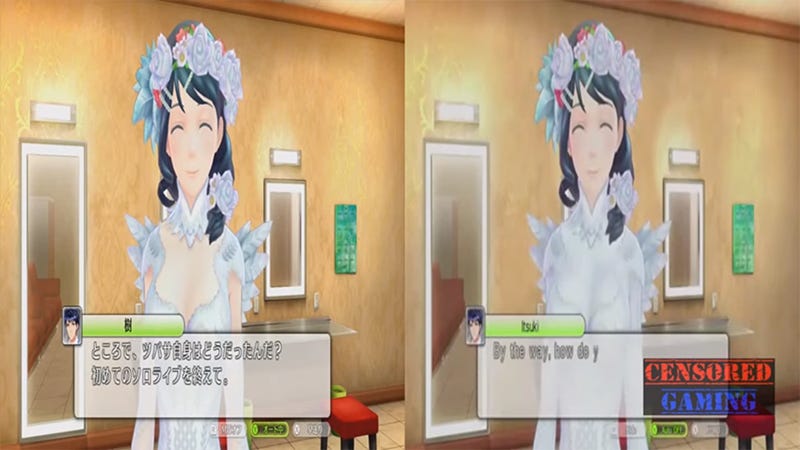
Furthermore, shoddy localization stems far more than just butchered translations. There have been many games, especially Nintendo published games, where the content is altered or ripped out from the original Japanese release. The petting minigame in Fire Emblem Fates is absent in the European and American releases. Tokyo Mirage Sessions #FE was hit rather hard by Nintendo of America's censorship. Cleavage and skin were covered up, a swimsuit costume was changed to street clothes, hip bones were removed, and the hot springs DLC was omitted.
These types of 'localterization' practices can break a consumer's enthusiasm for a game. While there are those gamers who will pan the camera under a character's skirt or swap out the default armor for a bikini, there are those who abide by the principle that a creator's work should never be altered. There is also the notion that censorship is condescending, where localization teams think the audience cannot handle the uncensored material and claim to "know what's best for you" without asking for consumer feedback. This infantilizing attitude perceived by consumers dissuade them from buying a game publisher's product, which negatively affects earned revenue.
What exacerbates the situation is that some people defend these practices, claiming that they are par of the course when it comes to localization. However, many other publishers such as XSEED, PQube, and Idea Factory are able to localize their games without any difficulties in spite of having content that may be a bit lewd. Localization should be merely translating the Japanese language to western languages, conserving the tone and intent when certain phrases cannot be directly translated. Censorship, removed content, and shoddy translations are not localization, but rather 'localterization'. A childish play of words, but the term makes the point succinctly. 'Localterization' is where publishers alter the content and tout it as localization when it really is a perfect example of what not to do when localizing a game.