Wednesday, December 28, 2016

Op-Ed: Localization vs. 'Localterization' in Video Games

Video game localization is a crucial component for Japanese games as it enables a mutual relationship between western consumers and Japanese publishers. The games can reach out to a wider pool of potential buyers while the customers have a larger array to titles to choose from. However, localization is not a simple task as translating Japanese is tricky. Certain jokes and idioms will not make sense if directly translated. In those kinds of situations, it is best to come up with a different joke or phrase of similar tone, as explained by publisher XSEED Games.

Unfortunately, not all localization teams do this. In fact, far too often, they do not translate certain Japanese phrases and instead replace them with ones that have an entirely different tone and intent. Here is a good example from Xenoblade Chronicles X, where the localized text is on the left, original text in the center, and proper translation on the right. A few lines were even removed completely.

Localized vs. translated text from Xenoblade Chronicles X
This problem has occurred on other games like Bravely Second, Fire Emblem Fates, Tales of Hearts R, and Tokyo Mirage Sessions #FE.

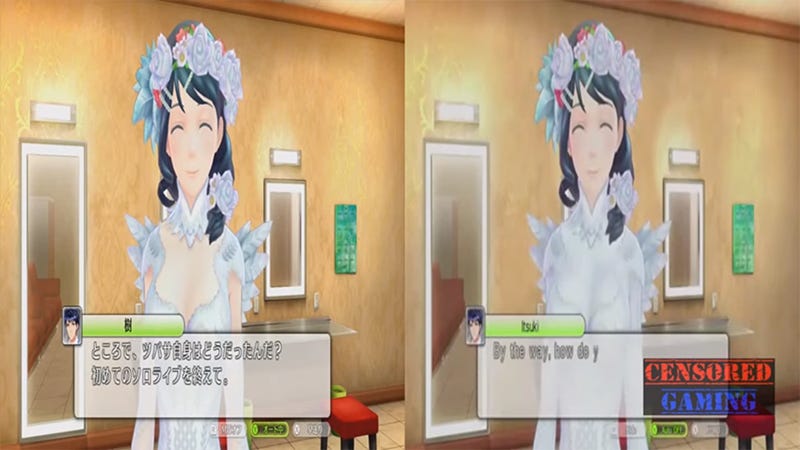
Furthermore, shoddy localization stems far more than just butchered translations. There have been many games, especially Nintendo published games, where the content is altered or ripped out from the original Japanese release. The petting minigame in Fire Emblem Fates is absent in the European and American releases. Tokyo Mirage Sessions #FE was hit rather hard by Nintendo of America's censorship. Cleavage and skin were covered up, a swimsuit costume was changed to street clothes, hip bones were removed, and the hot springs DLC was omitted.

These types of 'localterization' practices can break a consumer's enthusiasm for a game. While there are those gamers who will pan the camera under a character's skirt or swap out the default armor for a bikini, there are those who abide by the principle that a creator's work should never be altered. There is also the notion that censorship is condescending, where localization teams think the audience cannot handle the uncensored material and claim to "know what's best for you" without asking for consumer feedback. This infantilizing attitude perceived by consumers dissuade them from buying a game publisher's product, which negatively affects earned revenue.

What exacerbates the situation is that some people defend these practices, claiming that they are par of the course when it comes to localization. However, many other publishers such as XSEED, PQube, and Idea Factory are able to localize their games without any difficulties in spite of having content that may be a bit lewd. Localization should be merely translating the Japanese language to western languages, conserving the tone and intent when certain phrases cannot be directly translated. Censorship, removed content, and shoddy translations are not localization, but rather 'localterization'. A childish play of words, but the term makes the point succinctly. 'Localterization' is where publishers alter the content and tout it as localization when it really is a perfect example of what not to do when localizing a game.

Thursday, December 1, 2016

How the Left lost the 2016 Presidential Election (Part II): Political Correctness and the Shame Game

Political correctness has been at the forefront of multiple facets of society, from education to politics to activism. The left (or more specifically, the authoritarian left) has argued for political correctness because it avoids offending and marginalizing certain groups of people. On the other hand, the right and part of the left, particularly the libertarian groups of both sides, have expressed their dislike of the philosophy. Former comedian George Carlin described political correctness as "fascism pretending to be manners" and he is not off.

PC culture has two main aspects: the policing of expression and severe shaming of those who do not comply. Not only does it inhibit free speech, but it also ends up dictating what one wears or likes to do. A good example would be the far left's outrage over Halloween costumes because some are seemingly 'racist' and promote 'cultural appropriation'. Lecturer Erika and Dr. Nicholas Christakis spoke out against Yale University's excessively strict guidelines on what costumes are acceptable to wear. Their expression against self-censuring sparked outrage from the student body and irrational demands for them to resign. Erika Christakis eventually stepped down from her teaching position.

President-elect Donald Trump has openly spoken out against political correctness and one can obviously see his dislike of it from his brash speeches. As stated before, he criticized President Barack Obama for not acknowledging Omar Mateen's homophobic massacre as a radical Islamic attack. Obama defended his lack of acknowledgement by arguing that he did not want to generalize all Muslims as terrorists despite the fact that 'radical Islam' is a rather specific term. The mainstream media and the left berated Trump for being racist and Islamophobic.

Trump also received a lot of flak for speaking out against Black Lives Matter. He has criticized the movement for instigating attacks on police and expressing desire to murder cops during public protests. Of course, that did not sit well with BLM and the group labeled Trump as a racist white supremacist as a way to make him worse than he actually is. The shaming tactics ultimately did not work as not only did Trump win the general election, but he also received more black votes than Mitt Romney both in raw numbers and percentage.

The two-pronged attack of PC culture is evidentially dangerous as it restrains one's expression. It can also lead to unemployment, belligerent harassment or hindrance of needed social progress just because of mere disagreement. While Trump expressed opposition against political correctness, the left decided to double down on it. This made the Democratic Party rather unpalatable to numerous voters and the consequences were clear during the general election.